
Hlink | The marine law enforcement command and dispatch system has been successfully delivered, helping the Marine Development Bureau to unlock a new paradigm for emergency response at sea
Time:2026-01-23
Views:84
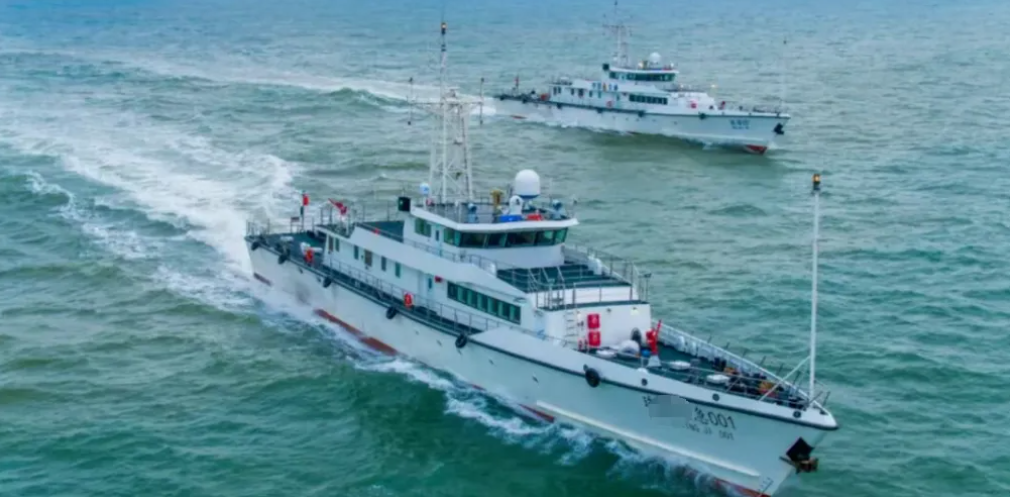
Ocean governance is the core cornerstone of marine ecological protection, production order standardization, and national security. A provincial marine management bureau is responsible for the daily supervision, law enforcement patrol, ecological protection, and emergency response of key nearshore and offshore waters in its jurisdiction, covering a vast area and complex tasks, which poses extremely high requirements for response time and collaborative efficiency. However, the current information construction highlights the fragmentation of equipment, blockage of ship-shore communication, and poor data interoperability, making it difficult for traditional law enforcement models to adapt to the modernized management needs of complex waters. Building an integrated and intelligent emergency command and dispatch system has become the key to breaking the deadlock.
Against this backdrop, Hua Wei Zhi Lian recently delivered an ocean law enforcement emergency command and dispatch system for a provincial marine development bureau, with technology to break through the governance bottleneck, injecting strong momentum into marine management and law enforcement work, and officially unlocking a new paradigm for marine emergency response!
The system, with "ship-shore synergy, all-domain interconnection, and precise dispatching" as its core, adopts a architecture design, which deeply integrates the deployment of ship-end equipment and the management and control of shore-end platforms, achieving a closed-loop full-process management from device access data transmission to instruction issuance and business interaction. It builds a solid and efficient maritime law enforcement operation center. The dispatching machine is deployed in the core of the ship-end which is used as the core node for equipment linkage and data processing. It accurately connects with the ship‘s sound mixing console through the audio gateway, ensuring clear and interferencefree voice dispatching within the ship and smooth internal communication among the front-line law enforcement personnel. Relying on the voice gateway, it seamlessly accesses the ship‘s, breaking the communication barriers between the ship-end and the shore-end, and between ships, and achieving real-time voice interconnection. The system is equipped with a dedicated gateway that is compatible with the UAV handle, which can synchronously transmit key data such as aerial photo and real-time positioning back to the dispatching terminal, allowing aerial patrols maritime law enforcement to form a joint force. At the same time, the ship-end dispatching console is equipped with a customized dispatching software, which completes the signal adaptation with VHF walkie-talkie through the cluster gateway, integrates various voice terminals, and completely ends the communication island problem of ship-end equipment。
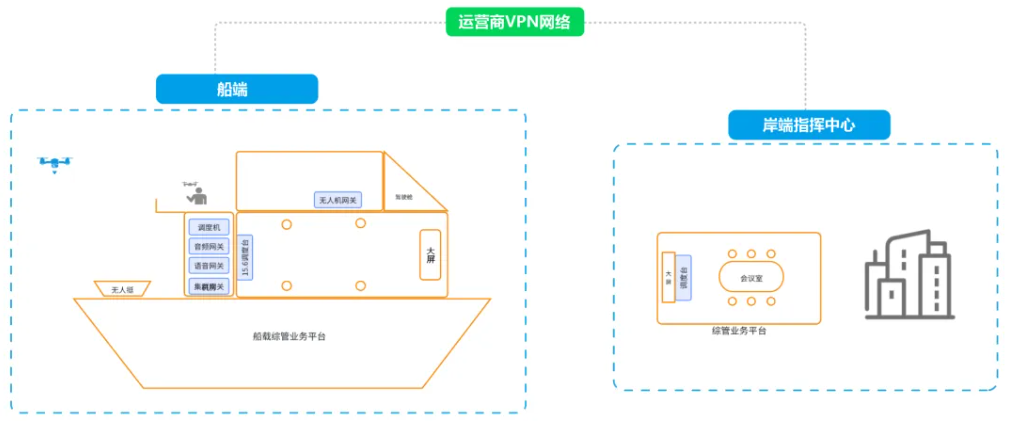
In view of the pain point of unstable network signal at sea, the system is equipped with a special network signal amplifier, relying on the operator‘s4G/5G network to build a high-speed and stable communication link. Even in the weak signal area of the distant sea, it can ensure that the voice, video data transmission are continuous and uninterrupted, which provides a network guarantee for the remote maritime law enforcement work. In addition, the ship-end integrated management business platform is deeply with the dispatching machine interface, comprehensively integrating the core business information such as the navigation data and water quality monitoring data inside the ship, and realizing the integrated presentation of law enforcement and ship operation data, so that the front-line law enforcement personnel can grasp the marine environment, ship status and the progress of law enforcement tasks in real time, and provide precise support for on-site disposal decisions.
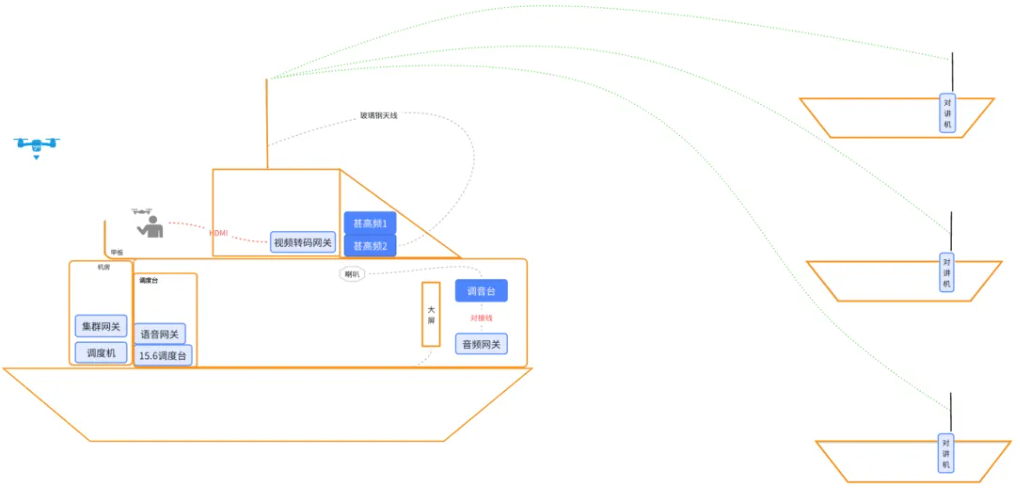
As the core control hub of all-domain law enforcement, the shore-based integrated management business platform has core capabilities such as remote access, data, instruction issuance, and overall scheduling, which enables centralized control and unified allocation of various ship-based equipment and business data. Through the shore-based platform, commanders can real-time multi-dimensional data such as navigation trajectories, water quality monitoring results, UAV patrol images, and voice communication records of each ship, comprehensively controlling maritime law enforcement dynamics maritime conditions. In the face of emergencies such as accidents and illegal acts, it can quickly issue scheduling instructions through the platform, link multiple ships to carry out collaborative disposal, and an emergency disposal pattern of "shore-based overall command, ship-based efficient execution, and all-domain collaborative linkage", which greatly shortens the response time and improves accuracy and efficiency of law enforcement disposal.
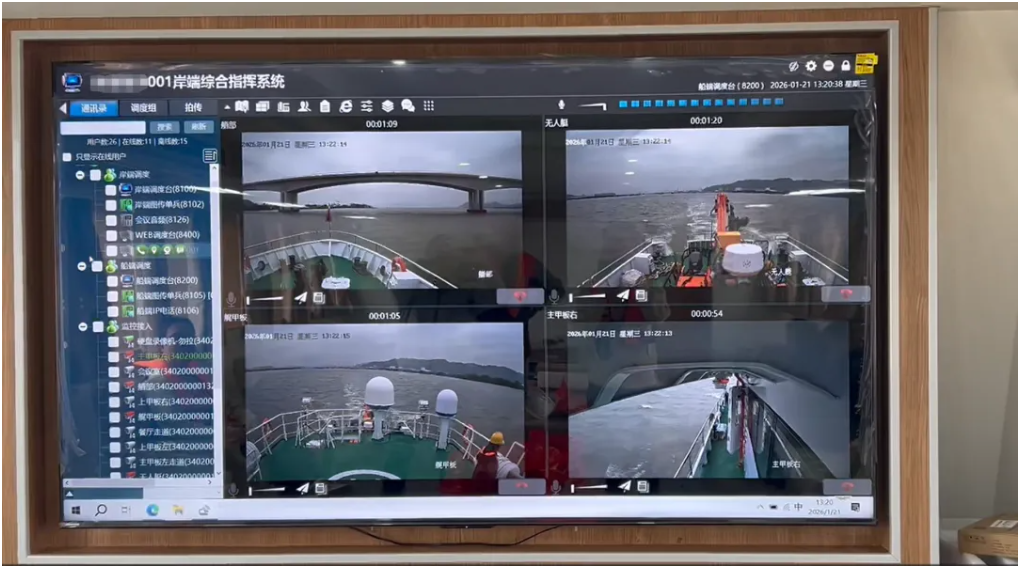
Shore End Command Center
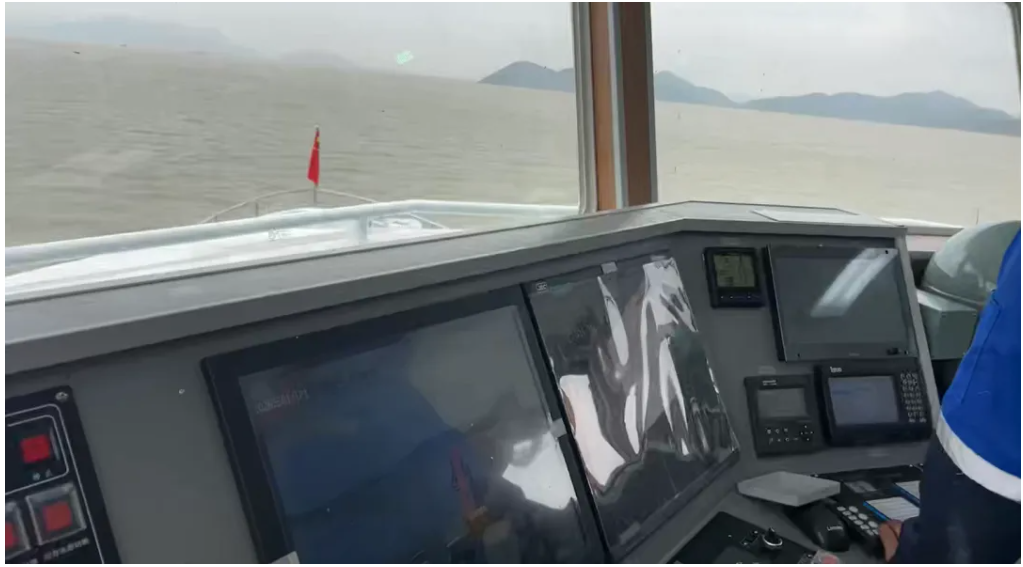
Bridge deck
The successful deployment of this system has completely changed the passive situation of traditional maritime law enforcement, achieving a transformation from "fragmented control" to " scheduling" and from "empirical disposal" to "data-driven decision-making". Real-time data synchronization between the ship and the shore allows the shore-based platform summarize, analyze, and store backup all law enforcement data, which not only provides authoritative evidence for law enforcement process tracing and responsibility determination but also optimizes law enforcement plans through data review continuously improving the ability to govern the sea areas. Whether it is the detection of violations and abnormal water quality monitoring during routine law enforcement patrols, or emergency rescue and multi- coordination in sudden accidents, the system can rely on stable equipment linkage, smooth ship-shore communication, and accurate data support to make law enforcement work more efficient, standardized, and.
From the precise deployment of ship-end equipment to the overall intelligent management of shore-end platforms, from the stable guarantee of network communication to the integrated of full-volume data, Hua Mai Zhi Lian‘s integrated communication emergency command and dispatch system, guided by practical combat needs, has resolved many pain points and in marine management and law enforcement. It is not only a "communication bridge" connecting ships and shore, but also an "intelligent engine" empowering the upgrade of law enforcement efficiency providing solid support for protecting the ecological safety of the sea area, regulating the order of maritime production, and strengthening the ability of marine law enforcement, and helping ocean governance enter a stage of intelligence and synergy.
 scan
scan
 15818654305
 address; Room 307, Building G, Jinhongfeng Mansion, No. 23 Liuxian Er Road, Xin‘an Street, Bao‘an District, Shenzhen City, Guangdong Province, China